Showing posts with label geopolitics. Show all posts

Friday, May 29, 2015

Nash, Lichauco, and Steering a Post-EDSA Economy


Share |
by James Matthew Miraflor

Deaths of great intellectuals diminish us all, but more so the scholars who are the main conduits of their work. In a span of a few days, students of the Philippine economy are shocked by the demise of two important paragons of the field – first, nationalist economist Alejandro Lichauco, and then game theory pioneer John Nash. The loss is simply incalculable.


Separated by miles and interests, the two celebrated economists used their Ivy League training to interpret and shape a world in conflict. Both are products of the Cold War, yet their ideas have persisted in a modern age of computer-driven, high-volume stock trading and post-WTO regional trade partnerships. While Nash is known mostly in microeconomics textbooks and Lichauco via word-of-mouth stories of Marcos dictatorship survivors, both have made their in impact in the minds of the Filipinos who keenly follow the country’s economic development.

Anyone interested in Philippine’s escape from the so-called “Middle Income trap” cannot afford to ignore the lives and contributions of these two illustrious economists. It is now more than ever – in a world of uncertainty, hegemonic overtures, and political machinations – that we should review the lessons of Nash and Lichauco. Game theory and nationalist economics are indispensable items in our toolbox as we chart the Philippine’s economic future amid multidimensional issues of China’s territorial expansionism, the Mindanao conflict amid ASEAN geopolitics (read this, and this), and America’s seductive offer for trans-Pacific trade.

Tuesday, January 8, 2013

Bangsamoro, the Devolution Failure, and India-style Federalism: A Case for Asymmetric Autonomy and Strategic Reapportionment


Share |
by James Matthew Miraflor*

The process is moving. Before 2012 ended, Philippine President Benigno Aquino III signed Executive Order No. 120 creating a Transition Commission (TC). The TC will supposedly draft the proposed Bangsamoro Basic Law stipulated in the Framework Agreement between the Government of the Republic of the Philippines and Moro Islamic Liberation Front (MILF).

This is indeed a breath of fresh air to a land scented by the smell of blood and war. GPH Negotiator and now Supreme Court Justice Marvic Leonen, a former Dean of the UP College of Law, was able to garb the whole process with political legitimacy and language of legality. If we are to accept a legal realist position, it is expected that the Supreme Court will decide in favor of ending the conflict and allow the evolution of a legal narrative for self-determination. Insisting on a constitutional change as a requisite to actualizing the agreement may end up compromising the gains for peace.

The Proposed Bangsamoro Core Territory based on the GHP-MILF Framework of Agreement.
Mindanews Graphics by Keith Bacongco. From here
But no doubt, the implementation of the Framework Agreement will raise questions on constitutionality and the framework's compatibility with our existing unitary system. No doubt, proposals for converting our current form of governance from unitary to federal will once again fill the pages of our dailies. It is inevitable then that we ask: would a shift to a federal system really be better for the Philippines? And if we do decide to shift, what model of federalism should we adopt?

These questions are asked in a context of a widely perceived failure in devolution and trends of increasing recentralization in health, social welfare, and local governance after the landmark Local Government Code of 1991. This essay argues that while federalism can be a plausible model for the country, it should be asymmetrically implemented (giving some territories more liberties than others) - following India's model. A strategic mix of recentralization and devolution, following some principles from the concept of Optimal Currency Areas (OCA) and urban agglomeration, is thus proposed as a way forward in implementing a reapportionment of political boundaries under asymmetric federalism.

Friday, December 28, 2012

The World according to Friedman: 2012 Geopolitical Analysis on US, China, Germany, and Japan


Share |
Clearly, for geopolitics, 2012 did not signal the world's end, but only its tumultuous continuity. Major economies of the world had seen their governments either replaced or reestablished - Barack Obama in the United States, Xi Jinping in People's Republic of China, and Shinzō Abe in Japan. Newsweek issued its last print issue, with the iconic hashtag sounding the death knell to non-online publishing. European Union remains to be stuck in a debilitating debt crisis. The UN General Assembly approves a motion granting Palestine non-member observer state status.

From here.
As we close this year, it is but fitting to listen to one of the world's best geopolitical minds  as he speaks on the state of the world, as well as the history and future of US, China, Germany and Japan. Let us all take a peek at the important insights George Friedman of Stratfor shared to us in 2012: 

The State of the World: A Framework 
By George Friedman | February 21, 2012

Editor's Note: This is the first installment of a new series on the national strategies of today's global power and other regional powers. This installment establishes a framework for understating the current state of the world. 

The evolution of geopolitics is cyclical. Powers rise, fall and shift. Changes occur in every generation in an unending ballet. However, the period between 1989 and 1991 was unique in that a long cycle of human history spanning hundreds of years ended, and with it a shorter cycle also came to a close. The world is still reverberating from the events of that period.

On Dec. 25, 1991, an epoch ended. On that day the Soviet Union collapsed, and for the first time in almost 500 years no European power was a global power, meaning no European state integrated economic, military and political power on a global scale. What began in 1492 with Europe smashing its way into the world and creating a global imperial system had ended. For five centuries, one European power or another had dominated the world, whether Portugal, Spain, France, England or the Soviet Union. Even the lesser European powers at the time had some degree of global influence.

Sunday, May 6, 2012

Transforming the 'Southeast Asian Sea' into a 'Shared Regional Area of Essential Commons' by Rasti Delizo


Share |
Hence, the Southeast Asian Sea’s strategic mineral and aquatic resources cannot be claimed by just a few and in the name of ancient empires that have long ago disappeared into the library of world history.  In the context of today’s global environmental realities, the Southeast Asian Sea must by now be claimed by the many and in the name of a 21st Century world order shared by all of humankind. - Rasti Delizo


TRANSFORMING THE ‘SOUTHEAST ASIAN SEA’ INTO A 
‘SHARED REGIONAL AREA OF ESSENTIAL COMMONS’

RASTI DELIZO*
12 April 2012

The regionally contentious body of water predominantly known throughout Asia as the South China Sea can yet be transformed into a more mutually beneficial regional asset.  Geographically located in Southeastern Asia, this vastly huge oceanic area is a historically recognized maritime route which expediently acts as a gateway between the Indian Ocean and the Pacific Ocean.  Many governments currently acknowledge its vital importance due to a vast abundance of natural undersea resources with potential wells of alternative energy supplies.  And for obvious strategic reasons, this prime bio-diversity spot has long become a regional magnet of attraction to various littoral states and major powers surrounding the area.

As such, China, Taiwan and four ASEAN (Association of Southeast Asian Nations) member-countries are now contesting certain sections of the South China Sea for these same reasons. These territorial claims have characteristically alerted other powerful states and multilateral organizations to the pending disputes as they certainly have the potential to spark off a future military conflict.  Since such a war could further conflagrate the entire Asia-Pacific region and inevitably become a dangerous global threat, this overarching regional issue continues to remain a top priority question begging for an immediate solution.

Wednesday, March 14, 2012

Uganda be kiddin' me*: Kony 2012, Ugandan Oil Boom, and America's Next Bin Laden


Share |
A parody pic by a hadtodoittoo posted here.
Kony 2012 has been perceived by many as one of the most effective advocacy strategies in the recent age of viral memes and social networks. Created and launched by the non-government organization Invisible Children, it has a simple objective: to stop and arrest international criminal Josephy Kony of the Lord's Resistance Army in any way possible. It's strategy is simple as well: get as much international support to push the United States (and possibly other states - they are very ambiguous on this) to do its usual thing of saving the world. But an originally all-American movement, the mobilization of support will naturally target the US populace. It's tactic: a year long spectacle of raising awareness, selling campaign paraphernalia, lobbying and leveraging  important personalities, and finally, direct action on April - seemingly riding the fad of creative protest actions sparked by of Occupy Wall Street and the Tea Party.

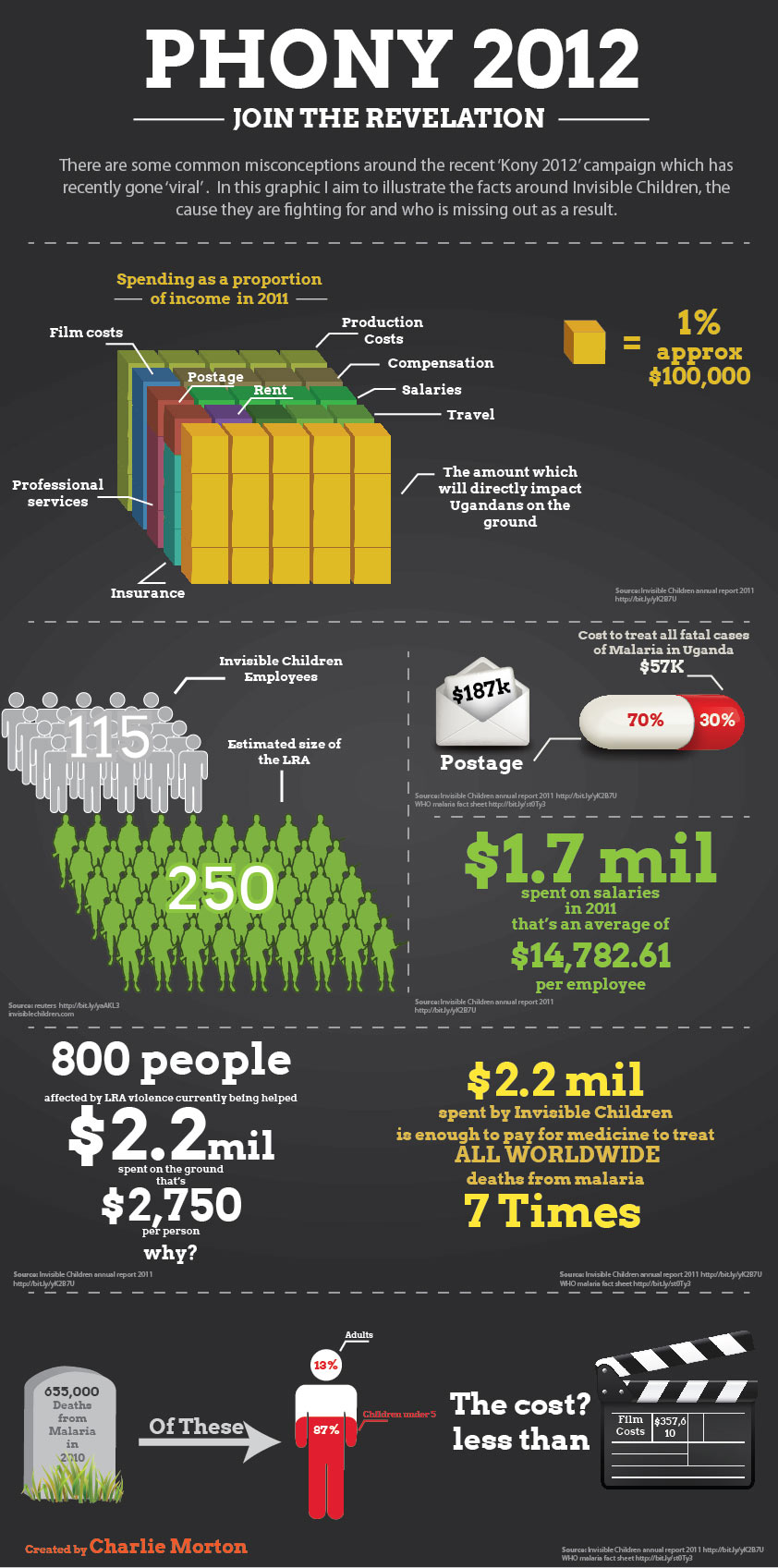
Unfortunately for them, Kony 2012, which gained considerable success in its air war - million hits for its videos, #stopkony trending globally, and sparking a global discourse on Africa and the existence of Christian fundamentalist militias (not unlike that created by the joint US and Philippines forces during the late 1980s, but more on this later) - backfired. Various criticisms had been hurled, from the mild accusation of oversimplification and misplaced attention, to moderate criticism on its failure to highlight and expose Uganda's poor human rights record - in effect condoning or even supporting it, to a vicious assault on Invisible Children itself - exposing the fact that very little actually goes to Uganda and African nations. Then there is also its push for US intervention, which flies in the face of sovereignty issues and the reputation itself of the US military. There are more comprehensive criticisms here, here, and here. (All of these prompted Invisible Children to issue a reply here).

Invisible children graphic
Invisible children graphic. Click image to see it.
Picture from the Guardian.
But, as we know, the issues can can still go deeper. For instance, we can think about how the Kony 2012 phenomenon is placed in the current political milieu. After all, Joseph Kony, the repressive Ugandan state, as well as "US-as-the-policeman-of-the-world" concept didn't emerge in a vacuum. There is always a historical and political context behind any phenomenon.

One of my most insightful friends Primo Morillo had this hypothesis about Kony 2012 and Uganda, a hypothesis I want to share with you. He proposed that Kony 2012's timing is impeccable - in fact, it coincides with the fact that there is recently discovered oil in Uganda. Verifying this assertion, I found out that there are indeed recent interests on a "Ugandan oil boom". This is what prompted me to write this post - which would center on Kony 2012 and the probable US interest on Ugandan oil amid rising oil prices, and its more important implication - that the US establishment is to create pretext for its petro-imperialism, similar to the demonization of Muammar Gaddafi. But I go further and propose that Kony is America's new Osama Bin Laden, meant to justify military intervention in resource-rich Africa.

Wednesday, November 5, 2008

Back to the Nation-State


Share |
Excerpted from the first draft of Fight Back: Reclaim and Expand the Lost Social and Economic Gains, Surge Forward Towards a New Economic Platform, a Freedom from Debt Coalition analysis paper written by the Debt and Public Finance Team (James Miraflor and Emman Hizon).

Directions for the System 

Now that the neoliberal system is going haywire, two directions are being presented in the status quo. The first direction, reasoning that it is not the direction but the intensity of pushing forward that is the problem, pushes us towards further market fundamentalism and advances the neoliberal project towards its completion – the total global economic integration and the absolute dismantling of the remaining free trade barriers.


We are now seeing how this paradigm works on how the rice crisis managed to do what trade talks failed to do – a unilateral reduction of crop tariffs of several countries – a solution forwarded by IMF-WB. Neoliberalism is still being presented as a solution, and in fact the problem is being portrayed as the half-hearted effort in implementing this philosophy of governance. This portrayal may not seem so obvious now, but it had been obvious before the collapse of main US investment and insurance houses.

Sunday, August 27, 2006

Games of States: Power Players in the Israel-Hezbollah War of Aggression


Share |
"The war in Lebanon then is not a war by the Arab or Jewish people but a war waged by its local elites managing their foreign-controlled governments. Whether or not wars like this will continue to be waged depends on the actions of the governments of these state actors, and inevitably, on the local elites which control the state apparatus."